Setting up and preparing the system for motion capture requires calibrated cameras.
This is a two-phase process that needs to be performed every time the cameras are placed or moved inside the capturing space:
calibration determines the position and orientation of the cameras inside the capture volume.
calibration aligns them with the floor. It can be performed at any time in a volume calibrated system to re-orient the global coordinate system. Its orientation is defined by the Moverse Calibration Board.
Confirm that all active camera feeds are streaming reliably without jitter and/or dropped frames.
2
Adjust Camera Framing & Coverage
Ensure cameras’ line of sights converge toward the center of the volume with equal top and bottom frame margins to observe a full body actor. For spatial layout specifications, see the System Setup Guide.
3
Start Collection
Click the Volume Calibration icon on the primary toolbar.
4
Collect Visual Marker Measurements
Enter the capture volume with the Moverse Calibration Board (see Calibration Accessories).
Traverse the volume while moving the board to be observable from at least 2-3 cameras simultaneously aiming to achieve good per-camera and volume coverage.
Higher quality calibration results are achieved when measurements are collected for multiple cameras simultaneously (3+). This requires orienting the board to be looking at the farther away cameras and moving perimetrically across the volume.
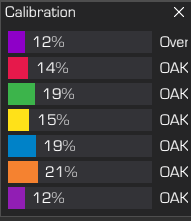
Observe the overall and per-camera collection process using the colored progress indicators.
Per-camera and cumulative calibration progress indicators.
5
Processing & Result
Upon reaching 100% completion, the calibration process starts and reports its progress.
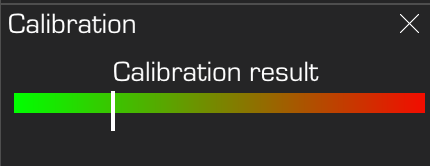
Once it is finished the calibration window will show the result’s quality score bar.
Spatial calibration quality indicator.
High-precision alignment is indicated by metrics trending toward the green zone.
If the quality score is sub-optimal, re-run Phase 1 before proceeding.
If the calibration metrics are above a pre-defined ceiling, the process will indicate that it has failed.
In this case the process of steps 2-4 should be repeated until an optimal result is achieved.
Place the calibration board flat on the floor at the desired origin location inside the capture space.
The origin is defined as illustrated on the calibration board.
2
Grab Measurements
Grab 5 measurements until the progress bar reaches 100%.
Before grabbing each measurement, move the board to a different position on the floor, visible by multiple cameras.
To trigger each measurement, click the magenta origin button adjacent to the icon.
The first measurement’s board orientation and position define the coordinate system’s orientation and the position of the origin ([0, 0, 0]).
Step 1 (20%)
Step 2 (40%)
Step 3 (60%)
Step 4 (80%)
Step 5 (100%)
Sequential origin calibration measurement sampling (20% to 100%).
3
Verify Origin
Once the progress bar disappears, the system is ready for motion capture.
Once an actor enters you can observe the global coordinate system orientation and position.
If you need to re-orient the system, simply perform steps 1-2 by adjusting the first measurement’s board placement.